Energy and Thermal Sciences Group (GECT)
(Updated on: 6 January
2026)
|
MISSION The
group is dedicated to the research, development, commercialization, and
deployment of sustainable energy and thermal sciences technologies. HISTORY Composed
of researchers in the areas of energy, fluid mechanics, thermodynamics, and
transport phenomena, the energy and thermal sciences group has been active on
the campus of the Federal University of Paraná
(Polytechnic Center) since 1996. Since
its creation, the group has been developing scientific research and
consulting in the areas of Thermal Engineering, Thermodynamics, Biomedical
Engineering, and Transport Phenomena. In particular, the group has developed
experimentally validated numerical simulation tools through experimental
measurements carried out in new processes and prototypes, for the design,
optimization, and development of new products. LABORATORIES The
GECT research activities are carried out in three laboratories: 1.
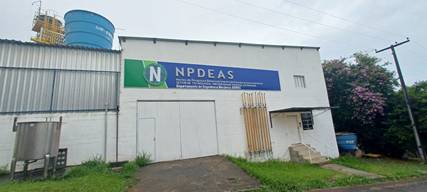
In the NPDEAS (Sustainable Energy
Research and Development Center), where scientific research is primarily
developed in the search for microalgae derived biofuels (e.g., green diesel,
sustainable aviation fuel – SAF, hydrogen) and other bioproducts (e.g.,
animal feed, plant growth promoters, metabolites prospection with
antimicrobial activity). Examples of the work accomplished so far are found
in http://dx.doi.org/10.1016/j.renene.2020.09.045
and http://dx.doi.org/10.1016/j.jenvman.2024.122141.
NPDEAS was founded in 2008 by the group leader, Prof. José Viriato Coelho
Vargas, who is the current coordinator;
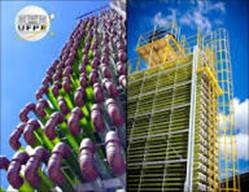
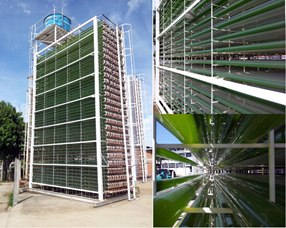
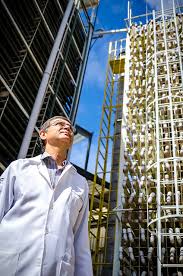
NPDEAS: Microalgae cultivation in 12 m3 PBR (5 m x 2 m x 8 m). https://patentimages.storage.googleapis.com/fa/2f/16/96764ac22d19ff/US10400202.pdf 2.
At LaCelC (Fuel Cell Laboratory), research is
conducted on the modeling and development of new alkaline (http://dx.doi.org/10.1016/j.ijhydene.2023.08.078)
and polymeric electrolyte fuel cells, seeking the development of new alkaline
and polymeric membranes, as well as platinum-free electrodes. The potential
production of sustainable green H2 is also under investigation
(e.g., microalgae derived H2 – http://dx.doi.org/10.1016/j.algal.2023.103065,
no energy input H2 production from fresh and sea water using scrap
aluminum from a well-established recycling chain through the Alkaline Aqueous
Redox Reaction of Aluminum, AARRA – http://dx.doi.org/10.1007/s11244-024-02041-4)
for either local power generation or building applications (e.g., cooking,
heating). LaCelC was founded in 2006 by the group
leader, Prof. José Viriato Coelho Vargas, who is the current coordinator;
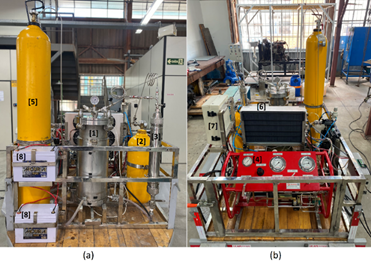
The developed H2 driven sustainable electricity
generation system: a) Front view, and b) Rear view. Main components: 1)
Reactor; 2) Buffer tank (bottle); 3) Gas drier; 4) Booster; 5) H2
storage tank (bottle); 6) 5-kW PEMFC stack; 7) Electric panel, and 8)
Stationary batteries. 3.
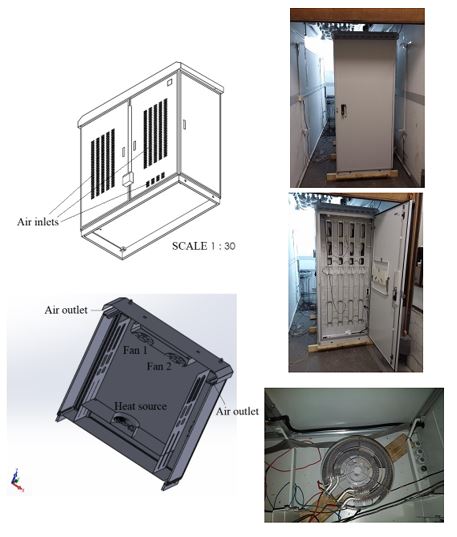
At LMH (Hydraulic Machines Laboratory), currently coordinated by Prof.
Stephan Hennings Och, research and development is conducted on cabinets for
housing electronics for various applications (e.g., telecommunications, cable
TV – http://dx.doi.org/10.1177/00375497211069979)
in collaboration with industry, as well as in the areas of refrigeration and
air conditioning, energy systems in general, and biomedical engineering.
Left:
Electronic packaging cabinet 3-D isometric perspective showing air inlets
(top) and cut showing internal components distribution and air outlets
(bottom), and Right: photos of the cabinet inside the test chamber (top and
center) and heat source (bottom). INTERNATIONAL COLLABORATION GECT
has maintained a scientific interaction since 2004 with the Center for Advanced Power Systems and Energy and Sustainability Center at
Florida State University, participating in several developments, including
the project for an entirely electric ship for the US Office of Naval
Research, via the Electric Ship Research and Development Consortium (ESRDC). .
José
Viriato Coelho Vargas is
currently retiring as a Full Professor at the Department of Mechanical
Engineering at Federal University of Paraná, UFPR, Curitiba, Brazil, and is a
Visiting Professor at the Department of Mechanical Engineering and the Center
for Advanced Power Systems at Florida State University. He leads the Energy
and Thermal Sciences group at UFPR, and develops theoretical, numerical, and
experimental scientific research in design optimization and systems
engineering in several areas: renewable and sustainable energy; energy
management in buildings and structures; innovative technology integration and
combination with the energy and thermal-fluid areas; smart HVAC-R systems;
oil refining processes; cogeneration and power systems; computational fluid
dynamics (CFD); heat and mass transfer; biotechnology and biomedical
engineering. The main ongoing works of the group involve the development of
new fuel cells, intelligent kits for HVAC-R systems, new absorption
refrigerators, thermal management of all electric ships, cabinets for
electronic packaging, the use of infrared imaging in engineering and
medicine, as well as the creation of a Sustainable Energy Research &
Development Center (NPDEAS) for microalgae derived biofuels (e.g., green diesel,
sustainable aviation fuel – SAF, hydrogen) and other bioproducts (e.g.,
animal feed, plant growth promoters, metabolites prospection with
antimicrobial activity). EDUCATION
AND TRAINING ·
PhD, 1994, Duke University, USA, Mechanical
Engineering PhD
Dissertation title: Combined Heat Transfer and Thermodynamics Problems with
Applications in Refrigeration Supervisor:
Adrian Bejan ·
M.Sc. 1992,
Pontifical Catholic University
of Rio de Janeiro (Pontifícia Universidade Católica
do Rio de Janeiro), PUC-Rio, Brazil, Mechanical Engineering Master’s Thesis title: Initial Values
Searching Method for Solving Non-Similar Boundary Layer Problems Supervisor: Francisco Eduardo Mourão
Saboya ·
B.Sc., 1989,
Military Institute of Engineering (Instituto Militar de Engenharia),
IME, Brazil, Mechanical and Automobiles Engineering Senior Design Project title: Design and
implementation of an automatically controlled hydraulic bench. Supervisors: Mauro Speranza Neto, Ney
Bruno and Adilson Augusto Baptista ·
B.Sc., 1980,
Black Needles Military Academy (Academia Militar das Agulhas Negras), AMAN,
Brazil, Business Administration (Military Sciences) ·
B.Sc., 2013, Federal University of Paraná (Universidade Federal do Paraná),
UFPR, Brazil, Biology Monography title:
Modeling and simulation of hydrogen generation process through microalgae
cultivation in compact photobioreactors Supervisor: David
Alexander Mitchell RESEARCH AND PROFESSIONAL EXPERIENCE 2004 – present: Visiting Scholar, Center
for Advanced Power Systems, Florida State University, USA (one 3-month
appointment per year), except for 2021. 1996 – present: Full Professor,
Department of Mechanical Engineering, Federal University of Paraná, Curitiba,
PR, Brazil. 1973 – 1996: Major, Military Engineers
Board, Brazilian Army. 2022 – 2024: Director of the Graduate
Program in Mechanical Engineering (PGMEC), Federal University of Paraná,
Curitiba, PR, Brazil. 2008 – present: Director, Sustainable
Energy Research and Development Center (NPDEAS), Department of Mechanical
Engineering, Federal University of Paraná, Curitiba, PR, Brazil. 2008 – 2010 and 2013 – 2022: Adjoint
Coordinator, Area of Materials Science, and Consultant, Area of Engineering,
CAPES, Ministry of Education, Brazil, respectively. 1999 – 2003 and 2007 – 2009:
Deputy-Director and Director of the Graduate Program in Materials Science
Engineering (PIPE), Federal University of Paraná, Curitiba, PR, Brazil,
respectively. 1995 – 2003: Visiting Scholar, Department
of Mechanical Engineering & Materials Science, Duke University, USA (one
3-month appointment per year) 1997 – 2025: Courses taught at Federal University of Paraná, UFPR, Curitiba,
PR, Brazil: GRADUATE LEVEL: Convection Heat and Mass Transfer Advanced Engineering Thermodynamics Computational Fluid Dynamics I Computational Fluid Dynamics II Computational Heat Transfer Structural and Thermal Analysis by the Finite
Element Method Scientific Programming in Fortran Thermal Radiation Heat Transfer Simulation and Control of Physical Systems UNDERGRADUATE LEVEL: Numerical Calculus The Finite Element Method Thermal Machines (Propulsion) Simulation and Control of Physical Systems Fundamentals of Thermodynamics Fundamentals of Heat and Mass Transfer Thermal Radiation Heat Transfer Thermoeconomics |