
| Vol.
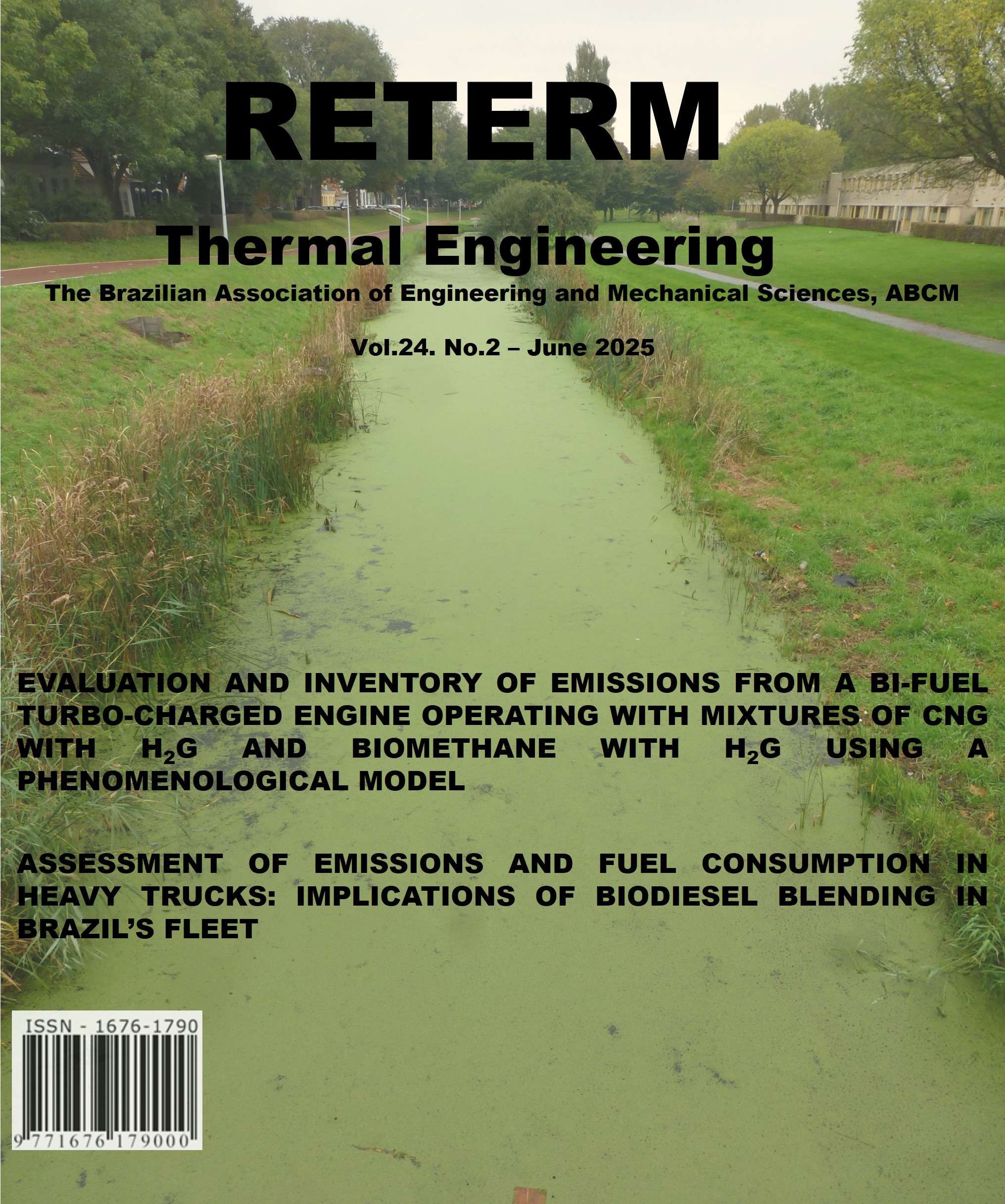
24 - No. 2 June 2025 ISSN 1676-1790 |
AIM AND SCOPE |
FOR AUTHORS |
EDITORIAL |
STAFF |
CONTACT US |
| HOME |
You must have Adobe Acrobat Reader or Foxit Reader
for visualization of the articles. Click here to download Adobe |
| Partners |


| Editorial | ||
|
The editorial of Thermal Engineering of this issue continues the discussion on scientific research needs in vital areas in which thermal engineering has important participation. The main goal is to motivate the readers, within their specialties, to identify possible subjects for their future research. Thermal machines, the foundation of Thermal Engineering, have played a central role in the history of industrial and technological progress throughout humanity. In this sense, from the Industrial Revolution to modern systems of electric power generation, automotive propulsion, and industrial processes, these devices have been fundamental to economic and social development. Currently, in the face of the global challenge of mitigating the environmental impacts of energy generation, thermal machines are entering a new era of transformation—marked by the relentless pursuit of greater efficiency, reliability, and sustainability. Thus, the current landscape, characterized by growing energy demand and the urgency of transitioning to cleaner sources, poses unprecedented challenges to Thermal Engineering. Initiatives involving the development of more efficient thermodynamic cycles, advanced materials capable of operating under extreme conditions, and strategies for waste heat recovery have become crucial. Furthermore, new frontiers are being explored, such as microthermal systems, the use of supercritical fluids, and heat recovery at previously unimaginable scales. In this context, four promising areas of advancement stand out: (A) the optimization of classical cycles—such as Brayton, Rankine, and Otto—through the incorporation of emerging technologies; (B) the development of more compact and efficient engines and turbines, especially for space and aerospace applications; (C) the integration of thermal systems with renewable sources, such as solar and biomass, promoting synergy between tradition and innovation; and (D) the use of advanced digital tools, such as computational modeling and artificial intelligence, to enhance performance and accurately predict failures. Heat recovery—whether in industrial processes, vehicular systems, or portable devices—represents another essential path toward increasing energy efficiency. Technologies such as regenerative heat exchangers, supercritical cycles, and engines based on alternative principles, such as thermoacoustic ones, expand the range of applications and reinforce the trend toward more sustainable and integrated thermal systems. Given this scenario, Thermal Engineering is being renewed and reaffirms its relevance, positioning itself as a key player in the search for smarter and more environmentally sustainable energy solutions. It is up to the academic and industrial communities not only to keep up with these transformations but to lead them, promoting scientific advancement and the practical application of knowledge for the benefit of society and the planet. The mission of Thermal Engineering is to document the scientific progress in areas related to thermal engineering (e.g., energy, oil and renewable fuels). We are confident that we will continue to receive articles’ submissions that contribute to the progress of science.
Sílvio Aparecido Verdério Júnior Gabriel de Morais Cordeiro
|
||
| . | ||
|
Authors | Editorial | Contact us | Staff | Ethics |
||
Old editions: Vol.1 - nº1 (before Nº1), Vol.1 - nº2 (before Nº2), Vol.1 - nº1 (before Nº3), Vol.1 - nº1 (before Nº4), Vol.3 - nº1, Vol.3 - nº2, Vol.4 - nº1, Vol.4 - nº2, Vol.5 - nº1, Vol.5 - nº2, Vol.6 - nº1, Vol.6 - nº2, Vol.7 - nº1, Vol.7 - nº2, Vol.8 - nº1, Vol.8 - nº2, Vol.9 - nº1-2, Vol.10 - nº1-2, Vol.11 - nº1-2, Vol.12 - nº1, Vol.12 - nº2, Vol.13 - nº1, Vol.13 - nº2, Vol.14 - nº1, Vol.14 - nº2, Vol.15 - nº1, Vol.15 - nº2, Vol.16 - nº1, Vol.16 - nº2, Vol.17 - nº1, Vol.17 - nº2, Vol.18 - nº1, Vol.18 - nº2, Vol.19 - nº1, Vol.19 - nº2, Vol.20 - nº1, Vol.20 - nº2, Vol.20 - nº3, Vol.20 - nº4, Vol.21 - nº1.,Vol.21 - nº2.,Vol.21 - nº3. ,Vol.21 - nº4.,Vol.22 - nº1.,Vol.22 - nº2., Vol.22 - nº3.,Vol.22 - nº4.,Vol.23 - nº1.,Vol.23 - nº2.,Vol.23 - nº3.,Vol.23 - nº4.,Vol.24 - nº1. Copyright © 2003-2024 |
||